
 |

In that way Sweden has taken the responsibility to preserve the rock carvings for the future. Many panels weather due to environmental pollution. An important aspect of preservation is to record the panels before it will be too late.

Tanums Hällristningsmuseum in Underslös has throughout the years made important contributions to this task.


Hardly distinguishable and/or weathered images can be identified by artificial light sources.

The images are covered by a sheet of paper, and rubbing is carried out with the use of carbon paper and grass

The rubbing method provides all details of a surface of a rock.
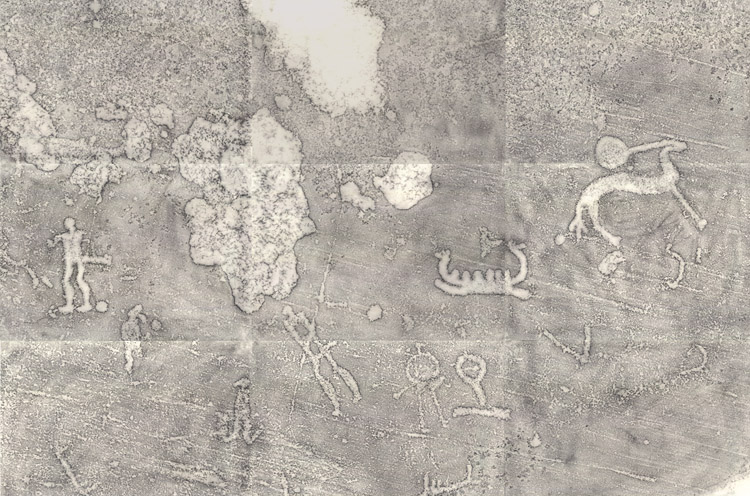
9 rubbing sheets have been digitalized and combined to show the complete composition

In order to achieve a painting as precise as possible demands a careful study of the surface of the rock in conjunction with a thorough comparison with the rubbing

The panel is painted with non-permanent paint, and is defined as an illustration.
Since 2013 the documentation of rock art has reached a new era with 3-dimensional documentation. The main methods are laser-scanning and Structure from Motion (SfM). The latter one is a photographic technique that creates 3-dimensional images of an object. The technique is already frequently applied during excavation, with astonishing results.
In May 2014 the Swedish Rock Art Research Archive (SHFA.se) started a pilot project commissioned by Länsstyrelsen i Västra Götaland, with the aim to document some of the rock carving panels at Aspeberget with this 3-dimensional technique. Expert in SfM Chris Sevara from the university in Vienna gives guidance in the making and processing of the photographs.
Since then the technique has been adapted to create not only 3-dimensional models but also ortho photos, showing the entire panel without distortion.
We have since then implemented the method for the documentation purposes with good results. These results have been published in our documentation series nr. 3 and 4 and the soon to be published nr. 5.

Example of a 3-dimensional rock carving processed with Structure from Motion
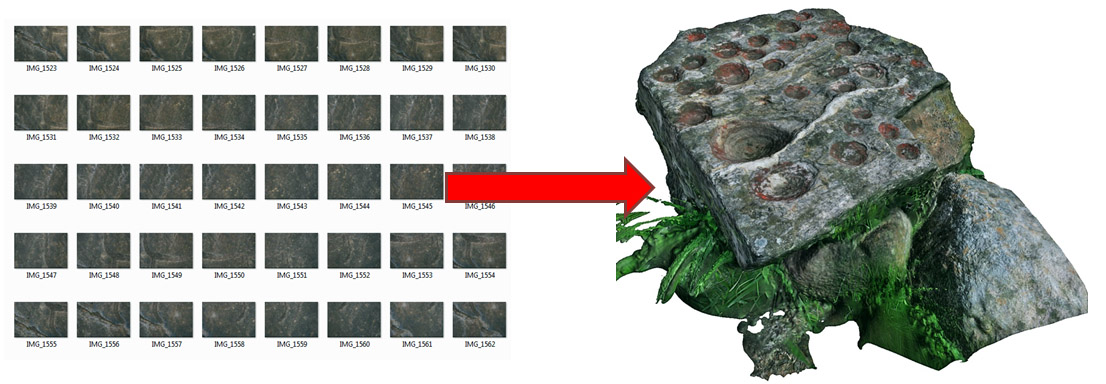
Orthophoto of the cupmarkstone at Underslös Museum.

